By clicking “Accept All Cookies”, you agree to the storing of cookies on your device to enhance site navigation, analyze site usage, and assist in our marketing efforts. View our Privacy Policy for more information.
Sugar Slayer Challenge - Week 4
Week 4 of the Sugar Slayer Challenge - A Look at the Bigger Picture
By
April 15, 2025

Related

Welcome to week FOUR of the Sugar Slayer challenge! Now that we've made some actual changes to our diets and begun cutting out the added sugar and sweetness, it's time to take a look at the bigger picture, and check in on our total consumption!
Where We've Been So Far...
We're at the point in this Challenge where real changes have been made (or are in progress!)
Week 1 - Find the Sugar, Make a Plan
The first week of the challenge was all about finding the sweet or sweetened foods in our everyday diets, and deciding what to do with them! The goal in Week 1 was to identify, then set some intentions to lower our total sugar intake
Week 2 - Reduce and Eliminate
Week two focused on reducing and/or eliminating unwanted foods in one of three ways: reducing the frequency you eat that food, reducing the amount of that food you eat each sitting, and diluting that food with another similar unsweetened version.
- Reduce Frequency: instead of eating that food every day, allow taht food to show up in your diet, but maybe two days per week instead
- Reduce Amount: Instead of the entire pint of ice cream, enjoy a small serving size, and then be done!
- Dilute: An effective way to whittle down your consumption of a sweetened food over time is diluting it with a non-sweetened "base". This method works well for things like salad dressing, yogurt, and soda. If you want, you can keep reducing the ratio of the sweetened version all the way down to zero over time!
Week 3 - Swap for Lower Sugar
Last week, we took the next step in reducing total sugar intake, and focused on teh foods we identified to swap with lower-sugar alternatives.
Swaps can happen when we're shopping for food, as we prepare food, and even at meal time! Swaps can be a 1:1 substitution, like swapping in plain yogurt instead of your usual sweetened variety. Or, you can swap based on the function that food provides, like changing your pre-workout snack from a granola bar to an apple and cheese stick.
Week 4 - Total Consumption!
As promised, this week we're turning our attention outward toward an overall view at our consumption.
Why Total Consumption Matters
When you remove sugary foods from your diet, your calorie intake drops. If you don't replace these calories properly, you might end up under-fueled, leading to short-term issues like lower energy, brain fog, and poor recovery. Over the long term, it can cause rebound effects or disordered eating behaviors.
Understanding Your Caloric Needs
So, how do we know if we're under- or over-fueling? We need to talk numbers! Finding the ideal numer of total calories for you requires finding your Basal Metabolic Rate (BMR) and then Total Daily Energy Expenditure (TDEE).
Calculate Your BMR
Your BMR is the number of calories your body needs at rest. You can determine this through an InBody scan or estimate it using online calculators.
On the InBody Scan sheet, your BMR is on the top right of the page, just below "Lean Body Mass". We like this approach the best because it's based on you, and your specific body!
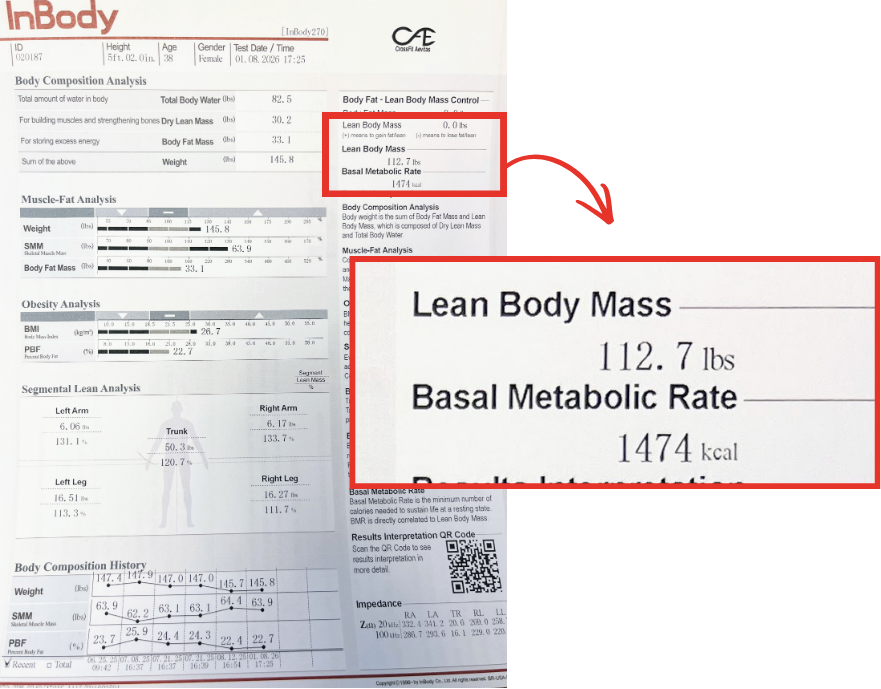
Don't have an InBody scan to look at? No problem! You can also estimate your BMR with a calculation that takes into account your height, weight, and age. While this approach is less specific to you, it will still get you into a reasonable ballpark!

Calculate Your TDEE
TDEE, or Total Daily Energy Expenditure, is the number of calories you need to live your life, including all of your daily activities and your exercise! TDEE is calculated by multiplying your BMR by an activity factor. The factors range from 1.2 for a sedentary lifestyle to 1.9 for very active individuals.
- Sedentary (office job, little exercise): 1.2
- Lightly Active (light exercise 1–3 days/week): 1.375
- Moderately Active (moderate exercise 3–5 days/week): 1.55
- Very Active (hard exercise 6–7 days/week): 1.725
- Extra Active (very hard exercise/training 2x day): 1.9
You did it! Your TDEE is a good reference for your target calories per day! This will give you a pretty good estimate at the number of calories you should shoot for, on average, to support your body and your lifestyle. View this number as a guide, not gospel! As long as you are generally within a reasonable range of this, you're most likely in a good spot fueling yourself properly!
An Optional Next Step: Balancing Macronutrients
Once you've established your caloric needs, consider your macronutrient ratios. Here's a quick guide:
Start with your Protein goal! You can determine your protein consumption goal in one of two ways:
- Aim for ~30% of your total caloric intake to be protein, or
- Aim for 1g of protein per 1lb of Lean Body Mass (the InBody will tell you what your Lean Body Mass is!)
Once you have a protein goal, you can divvy up the carbs and fat in a lot of different ways. In fact, if you were to look at 5 different articles on this topic, you would probably find 5 different answers and stances on what the "optimal" numbers are!
What we like to do, just to keep things simple: after calculating your protein goal, split the remaining calories somewhat evenly between carbs and fats. Viola! A simple way to achieve a balanced ratio of your macronutrients, without (too much) fuss!
One helpful reminder to make the math easier here:
- Protein: 1g = 4 calories
- Carbohydrates: 1g = 4 calories
- Fat: 1g = 9 calories
This will give you a little more insight into what a good goal for each macronutrient is, for you! Your actual numbers will depend on a lot of different factors, so again take these numbers as a guide, not gospel!
Your Week 4 Assignment
This week, track your food for at least four days. In addition, calculate your BMR and TDEE using the methods described above. Then, check in with yourself: are you eating way more or way less than the calculated TDEE? It might be worth making some changes in your total intake.
Remember, small, consistent steps lead to big changes. If there is a discrepancy, don't try to make it up immediately! For now, just think of ways you could add or reduce calories within your current eating habits to get you closer to the goal numbers. We will discuss more as we wrap up this challenge next week!
Keep up the great work, and let's slay that sugar monster together!








%20(3).png)
%20(2).png)


.png)












%20(1).png)

.png)